My title refers to two recently published poems I’ll tell you about in a minute, but in this fast-moving September, I’m also pondering how to inch along rather than run.
The academic whirlwind yanked me up into its funnel cloud this August with extra force, or so it seemed, after a sabbatical’s saner pace. Struggling with the workload, I thought with surprise, I do not want this. I definitely do not want to go to these endless workshops on how AI can help improve faculty efficiency. I want to take slow, inefficient walks in the woods, looking at mushrooms.
I was relieved, after that rush of meetings and paperwork, to settle into teaching. Preparing for class–reading, reconsidering old lesson plans (recently Rukeyser, O’Hara, Ginsberg, Plath)–I lose track of time. Running a discussion about literature or writing is all about giving texts and other humans the respect of unhurried attention.
Yet administrivia keeps pouring in, with deadlines that put firm boundaries on how much time I can give my students or my creative life. The latter involves its own administrative tasks, too: slipping a few submissions in before the windows close, checking proofs, booking a hotel for that writing festival, etc. When you get to the events, they’re often great. I LOVED the thoughtful conversation at the ecopoetry panel and reading I was a part of recently at Stone Soup Books. Blockage on the interstate, though, meant I broke speed limits getting there.
The unhurry-able process of writing, revising, and working to get poems in front of audiences has fruited lately, as a reminder of where rumination can lead. The Pinch just published the final section of “Ternary Systems,” a long poem I finished a first draft of during my December residency at the Betsy Hotel in Miami, thanks to SWWIM. Numbered in base three, it’s about logarithmic spirals, gender identity, hair, not being baby Moses, and channeling the Great Pink Sea Snail. The other, “Moonday,” in Whale Road Review, resulted from the single time I followed the advice of my former student and friend, Cameron Steele, that early morning on Mondays might be an auspicious writing time for me. (I don’t like Mondays OR waking early, hence my slacking off.) I meant the poem as a spell, inspired by something Jennifer Martelli said at a panel on poetry and shame at the Massachusetts Festival of the Book–about being done with that emotion, simply pushing it aside for good. Lowell’s “Skunk Hour” is surely part of its origin story, too. Skunks mean defiance to me because of that poem. Gratitude to the editors of those journals and to the organizers of two more events I’m preparing for:
- Sept. 23, 11:50 am-12:50 pm: Chris Gavaler & Lesley Wheeler: A Celebration of New Books, Northen Auditorium in Leyburn Library, W&L University, Lexington, VA
- Oct. 7, 2 pm: Reading with Carolyn Kreiter-Foronda, and Luz Schweig: Old Dominion Literary Festival, Perry Library, 1st Floor Academic Lounge East, ODU, Norfolk, VA
During the past year and a half, it felt like I presented from Mycocosmic everywhere EXCEPT my home institution, so it was really nice to be asked to speak here, as well as by ODU. Squeezing applications onto the to-do list can make life feel especially frenzied.

Currently I’m sifting submissions for Shenandoah‘s Graybeal-Gowen Prize for Virginia poets. This too makes the toll of speed clear. The first big heave was sorting the 201 batches (the most we’ve ever received for this prize) into “no” and “maybe,” and I have to be efficient–it’s unpaid labor, after all, on top of my regular load. It’s dispiriting, though, to work quickly through poems that another person labored long over. Well, not everyone. I received 17 identical submissions by the same person, not even in the right genre–was that a bot spamming me? A sticky key? A few batches were blandly generic enough that they could have been AI-generated, although I can’t tell for sure; I’ve always received some of that ilk. But mostly I can feel a real person in there, struggling with something in their idiosyncratic way, or trying to praise the world. Hey, me too. Hitting decline without time for a quick personalization can feel bad. I wonder: is this for me?
Then I get to the slow part, the smaller pool of maybes, and I remember that editing the poetry section of a magazine is a privilege. These poems can’t all be prize finalists, but it’s an honor to spend time with them. When I’m not slammed, I love it!
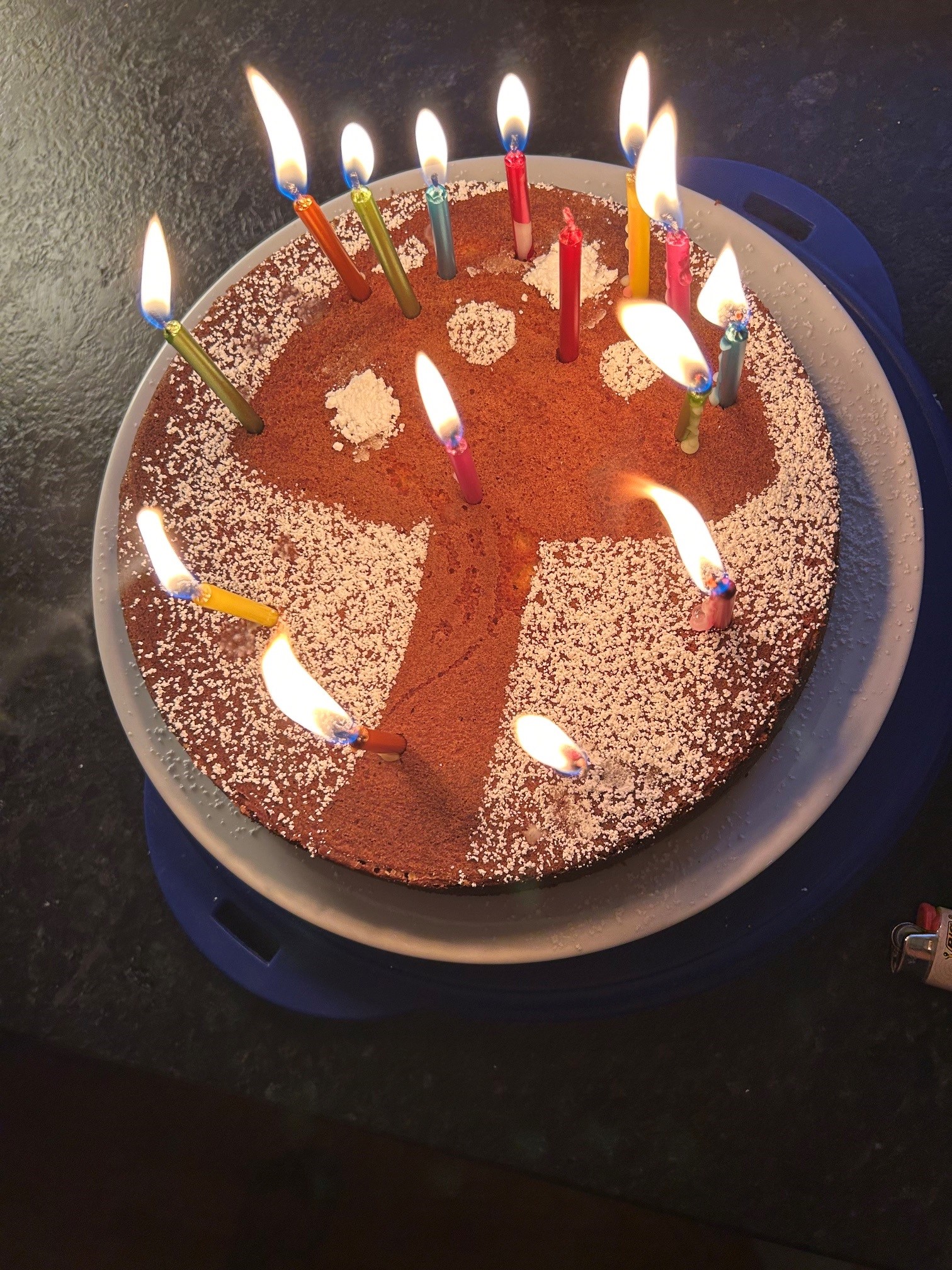
I’m going to have to say “no” more often. I’m taking more seriously the idea of retiring early, because I’m not made of the right stuff to shrug off this big job’s obligations. I’m also, for my birthday next weekend, taking off to a cabin in a West Virginia state park with Chris. No wifi or cell service: just us, the trees, and the mushrooms.


4 responses to “Snailing along in the moonlight”
“administrivia” — I love it. The term, I mean, not the, er, administrivia itself.
Enjoy the no-wifi woods and fungi and definitely take some time to consider what early retirement might feel like. Academics can keep teaching into their 70s (even their 80s…), but do you really want to?
I think that choice was easier when my dad was teaching; he kept at it until 78, though he lowered his course load. However, if there were AI on the agenda and even more administrative requirements than there were in 2016, I think he’d have bailed.
I certainly felt it was necessary for ME to leave work at 65. And though I am not perhaps finding quite as much time to devote to my writing as I’d hoped, I have definitely made progress, relaxed, been to seminars and retreats, and had a noticeable improvement in my health. All of which you deserve, my friend.
Thank you for all of this, Ann! So many people have told me their health improved when they left academia, and I have no worry about keeping busy in retirement, either. I wonder about the loss of professional identity, though, since I’ve leaned so hard, for so long, into professordom.
“Moonday” is such a beauty! May there be many mushrooms coming for you. 🙂
Thank you so much! All the rain this week is auspicious for those weekend walks!