I just had tea with the lovely poet, person, and letterpress publisher Emily Hancock of St. Brigid Press. She’s planning an ecopoetry event at Stone Soup Books in Waynesboro, Virginia on September 13th, and I’ll be part of it, with Jeanne Larsen, Sarah Ann Winn, and, we hope, a relative of Karenne Wood to discuss that poet’s work. We batted around possible panel questions as well as talking about midlife, meditation, ADHD, children, and fur babies. Two red threads were the topics of attention and connection: how writing and reading as practices help us attend to the human and the more-than-human worlds, as well as forging unlikely but restorative connections among them.
Connection is my “Flood subject,” to use Emily Dickinson’s phrase (hers was immortality). Of my books of traditional poetry scholarship, one focuses on enclosure, the other voice–communication, that is, and the various twisty, indirect, yet resonant ways poems speak or perform silence. Talking about poems in classrooms and criticism has been my livelihood. I love it; my introversion somehow yields, or even becomes an asset, when I’m part of a group passing around, analyzing, and admiring a “machine made of words” (that’s W.C. Williams). But poetry as communication? As I’ve written elsewhere, a poem makes a lousy telephone. The signal is just too delayed and beset by noise. The strongest poems convey urgency, yet if you have a message that’s urgent in the usual sense–“Help, my car broke down!” or even “I love you, please move in with me”–you should probably choose another linguistic medium to make sure it gets through.
Yet I receive poems as communication all the time and am wildly grateful for the mind-to-mind, long-distance, time-machine-style intimacy they enable. I often write, too, as a way to imagine perspectives alien to mine, how a tree might think, or a mountain, or a god. That’s not to claim I get it right, ever. But there’s value in the attempt.
*
A few weeks ago, as magazine rejections trickled in (they’re still coming) and I watched prize nods go to other books than Mycocosmic, I was hit by a bout of poetry envy. It’s an unpleasant and unproductive infection–unjustified, too, because I’ve been lucky enough–but every poet I have frank conversations with catches the bug sometimes. Then a message arrived, in prose far less cryptic than any letter Dickinson sent to Thomas Wentworth Higginson: would I send a headshot? My poem “Return Path” would appear on The Slowdown the following week, on July 21. An attention-hungry poet thereby felt relieved by a timely pat on the head.
“Return Path” is about connection and has been an instrument of connection, too. As host Maggie Smith observed in the podcast, its use of the circuit metaphor and references to ritual and prayer fit the villanelle’s architecture of repetition: two lines repeated four times each; two rhymes controlling the whole poem; an iambic pulse. I deploy all of those repetitions in slant, messy, imperfect fashion because I’m most drawn to received forms in that style–echo and deviation. I could defend the preference intellectually, but really, it’s just taste. We all like slightly different balances of tradition and surprise. As poet David M. Katz observed about the poem in an FB post, the poem also shows my liking for scientific vocabulary. I enjoy how scientific words rub against the grain of a poem, polysyllabic difficulty disrupting the language of emotion and lyric poetry’s prettiness. I’m sure the habit puts some readers off. Also taste, and quite fair.
The word “mycelial,” though, wasn’t even in the first published version of the poem in the 2018 anthology Love Affairs at the Villa Nelle, edited by Marilyn L. Taylor and James P. Roberts. I revised “Return Path” later, as I was building the 2025 book Mycocosmic, realizing that a mycelial metaphor was already latent in the poem’s obsession with the ground beneath us. This fungally tinged iteration was chosen for the 2023 anthology Dear Human at the Edge of Time, edited by Aileen Cassinetto, Jeremy Hoffman, and Luisa A. Igloria. I often close my public readings with “Return Path” now; audiences respond well to it. Just before the note from a Slowdown producer, I’d received a letter, in fact, from a former student who taught it to his high school class. This lucky poem gets around.
“Return Path” also reflects a supernatural conversation (although you could see it as scientific or psychological). I’ve sometimes felt a presence at a certain bend in the stream I walk along regularly, and one day I asked that spirit of place for help. I don’t remember the problem worrying me, just the goosebumps that lifted on my arms when I felt an answer rise up. I asked what gift I could give in return, and the presence? some part of my own weird brain? answered, Die. Of course that’s what the earth wants from us. We’re collections of elements on loan from the planet; the planet wants them back and has limited patience for human stalling.
“Return Path” arose from trying to talk with an intelligence beyond myself. Poetically it’s in conversation with other villanelles I love, including one Maggie Smith mentions, Elizabeth Bishop’s “One Art,” which uses and misuses the form fabulously. I chose the mythic word “plutonic” inspired by Jan Beatty’s use of it in “Red Sugar,” another poem I adore and wrote about for Poets & Writers and in Poetry’s Possible Worlds. More returns, with a spooky sense of being spoken to by letters on a page as well as by a presence in the local bottomland. Circuits of attention and fragile, covert, trans-temporal connection: when poetry helps us communicate, this is how.
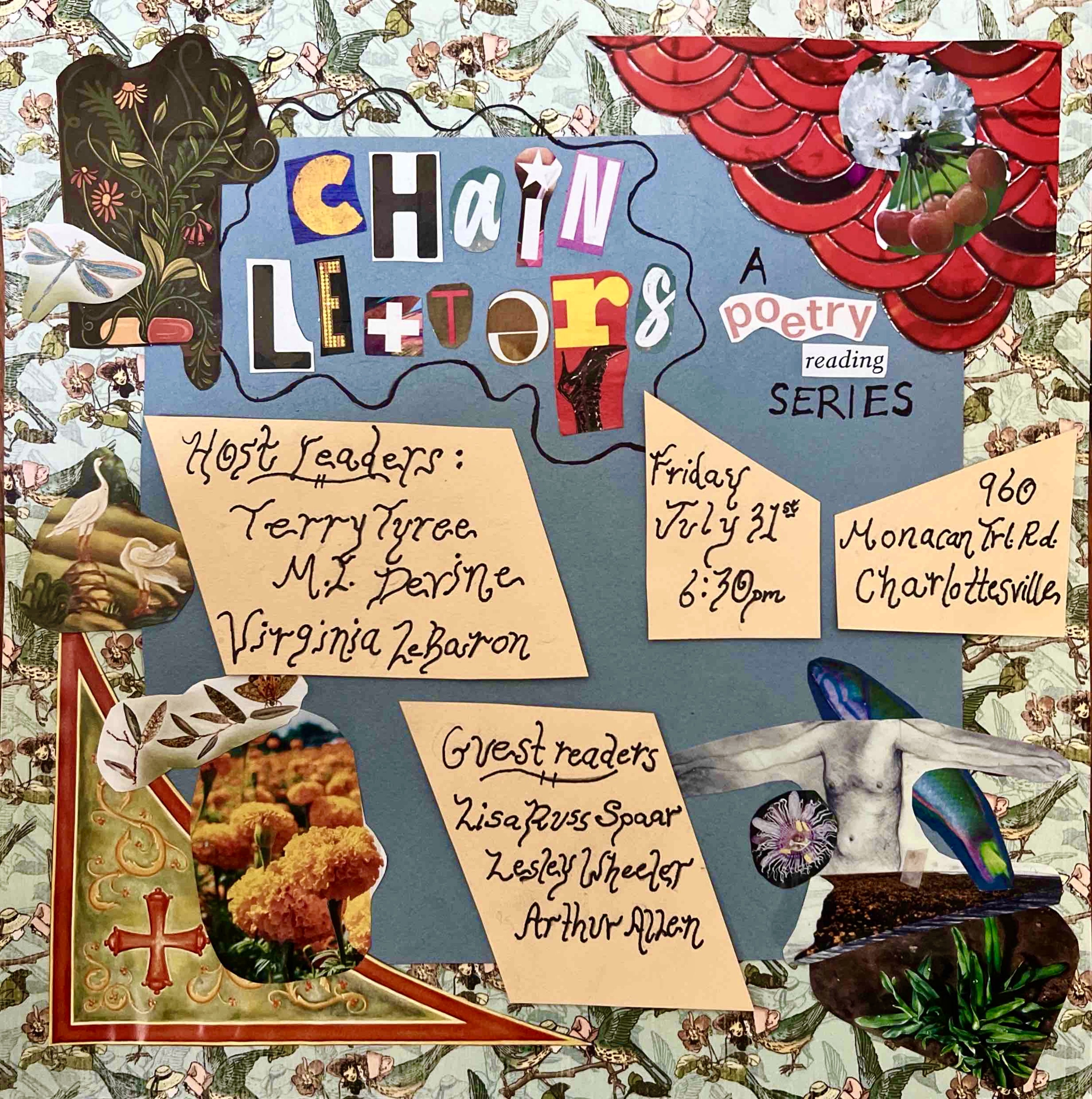
If you’d rather talk-talk and live in or near my watershed, I’ll be reading in the Chain Letters series in Charlottesville, July 31st, 960 Monacan Trail Road. The format: three poets read briefly, introducing three more poets, who’ll read again in the next season with three additional poets they tap. Circuitous!


5 responses to “Poetic circuitry”
“Circuits of attention and fragile, covert, trans-temporal connection: when poetry helps us communicate, this is how.” Yes, wonderful! I’m so glad to be a node on your intricate web of connections.
It’s mutual!
Loved the explanation of connections as your ‘flood subject’ and I listened to your Slowdown episode yesterday. Congratulations! Hope the beach was a good visit.
For some reason (perhaps my oft delayed blog reading schedule) I’ve been unable to comment here this summer, but late congratulations on the Slowdown selection.
Thanks, Frank!