
My two fall classes are a first-year writing seminar called “Other Worlds” and an advanced poetry class called “Haunted & Strange,” so as autumn starts, I’m feeling weird in a good way. I’m also reading Robert Duncan’s The H.D. Book, full of meditations on poetry’s magic and modernism’s intersections with the occult, and wow, I can’t believe I’m coming to this book so late! Born in 1919 in California and adopted by theosophist parents, Duncan briefly attended Black Mountain College but is most associated with the San Francisco Renaissance. I’ve taught bits of his poetry alongside work by other Beat and antiwar writers. I’d also read fragments of The H.D. Book as I wrote a dissertation chapter that became a book chapter on H.D., but Duncan’s constantly-revised, long-privately-circulated opus wasn’t widely available then. The 2011 edition of The H.D. Book edited by Michael Boughn and Victor Coleman divides into two large sections totaling nearly 700 pages, so although I bought the book a dozen years ago, I was intimidated by its length.
Yet Duncan’s tome is the kind of idiosyncratic project I love, and a book I’ve perhaps been needing for a while. It intertwines thoughts on poetry, women writers who got sidelined, Madame Blavatsky and the Order of the Golden Dawn, and much more. In blending criticism with personal stories, it’s very much in the spirit of my Poetry’s Possible Worlds. A ghost I didn’t recognize was haunting me.
I’ve finished Book One, which consists of beautiful, insightful essays in a digressive, meandering mode. I’m underlining half the text but here are a few quotes that stay with me particularly. About a high school teacher reading H.D.’s “Heat” aloud to Duncan’s class one day:
But there were times when Miss Keough all but confided that the way of reading required by our project was not only tedious but wronged what we read…she would present some poem or story as if it belonged not to what every well-read person must know, the matter of a public establishment, but to that earlier, atavistic, inner life of the person. (37)
Duncan writes about finding alliance and kinship with writers, especially H.D. but including others, through such poetic magic, describing several poems as prayers and invocations. H.D.’s “Heat” is “magic in its intent and not literary” (54). “Sea Rose” is “a witchcraft or spell” (74). As I’ve argued before, I think many poems are powerful because of this resemblance. I took a break from drafting this blog to watch via YouTube an electrifying reading by Evie Shockley at the Furious Flower conference. She closed with “les milles” and it sounded very much like a spell-poem against atrocity, invoking a fuller practice of listening and speaking out. I can testify that contemporary poetry continues to channel uncanny potential for transformation.
Later Duncan recalls his fairy-named Aunt Fay telling him that the soul “is like a swarm of bees, and, at night, certain entities of that swarm left the body-hive” (125). (Whoa.) Writing about “the drama of our time” as the coming together of all people in a shared fate, through a “world ecology” among other forces (153), he argues:
The very heightened sense of the relatedness of everything sets poets apart. The very secret of the impulse in poetry is the troubled awareness the poet has of meanings in the common language everywhere that those about him do not see or do not consider so important. (188)
In the same chapter he describes a “magic reciprocity” in a poet’s identification with the natural world and comments that “those critics” who have “rebuked” H.D. for her early poems “may be disturbed by content in the poem they do not want to recognize” (195). He means a mid-century generation of critics, but I’ve heard several currently prominent poets and scholars dismiss her work, so I appreciate the zinger. Articulating your taste is fine–nobody likes all poetry–but when you set out to take down a poet who has meant a lot to many readers, something else is at play.
Duncan’s thoughts are strongly resonant with my forthcoming poetry collection Mycocosmic, which foregrounds spell-poems and mycelium-style interrelatedness. Reading The H.D. Book intensifies my desire to share Mycocosmic so much that I can hardly bear it. I’ve been on the cusp so long! The cover and interior design are still not quite done, and I’m holding onto the beautiful blurbs a bit longer–but I hope the shift in weather and season will soon tip this project into the light.

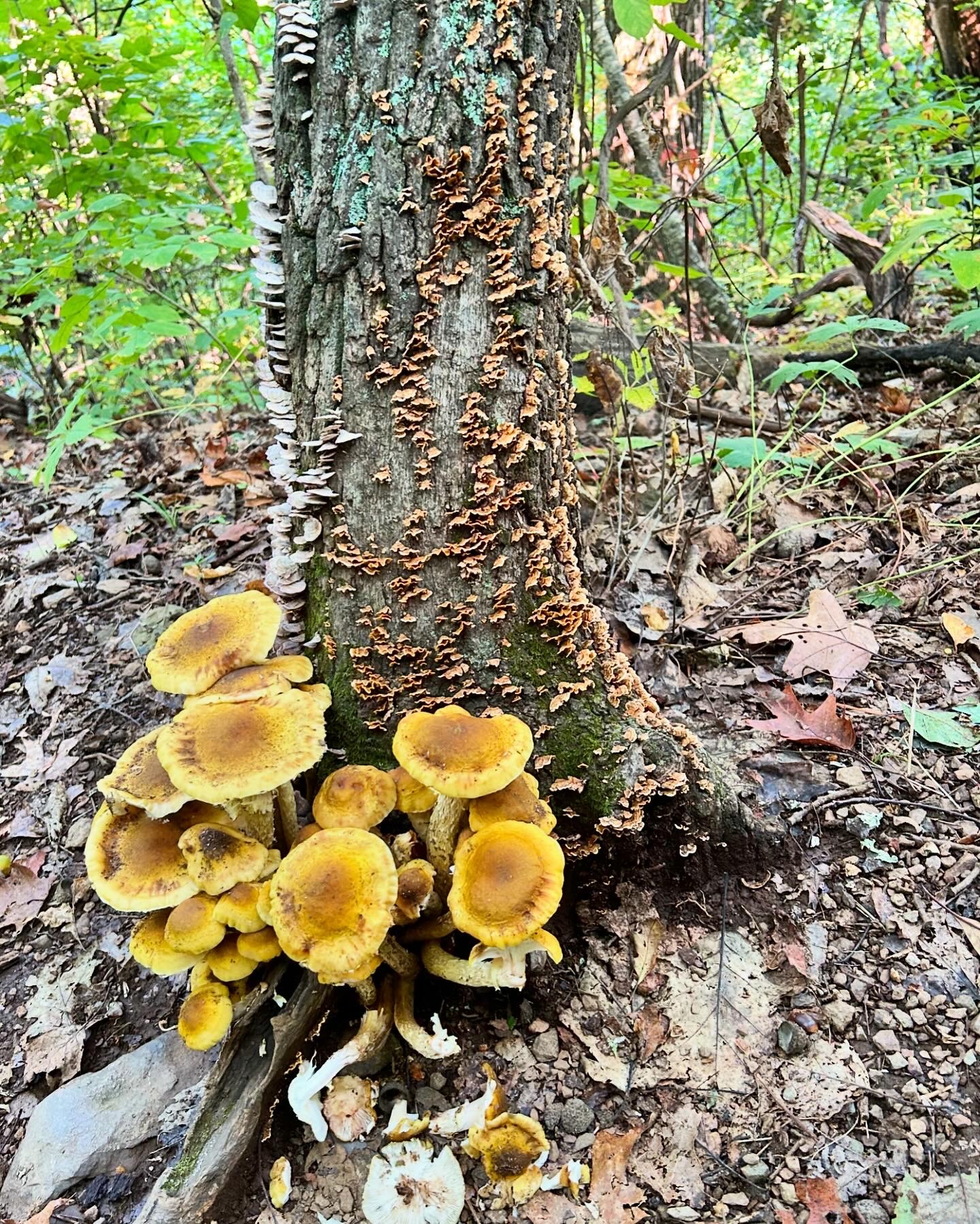
**All the pictures are from a post-work hike I took Friday, the Jack Allbright Loop off the Blue Ridge Parkway, overlooking Glassy Hollow. We then cleaned up and went to a fancy dinner at a winery in early celebration of my birthday this week. It was LOVELY, even though I tweaked my bad knee on the rocky trail and am struggling with stairs again. I’m also tipping into an especially busy week in terms of meetings and events, so wish this Libra some physical and mental balance, please!
 LESLEY WHEELER
8 responses to “Magic reciprocity”
wishing you a very magical birthday week!
LikeLiked by 1 person
Thank you very much!
LikeLike
Happy birthday! Wishing you a balanced week with a bit of whimsy.
LikeLiked by 1 person
Thank you–and hoping your foot is much better!
LikeLike
It’s much better. I need to test it on a hike soon instead of just road walks. Hope your knee is better.
LikeLike
LikeLiked by 1 person
Thanks so much, Cynthia!
LikeLike
[…] Lesley Wheeler, Magic reciprocity […]
LikeLike