“Poet or poem or reader, the same/ ectoplasm,” Diane Seuss writes in her latest collection. I’m reading and writing poetry with ardor again, feeling that welcome ectoplasmic connection. I don’t know if my creative brain is clicking into gear because of the season (I often go dormant in winter and start writing again in the spring), or because I’m teaching three poetry-related classes that are now at peak energy before the end-of-term slide to home (but not before my class puts on a Haiku Death Match!–see the flier below). In any case, the ability to channel poetry again is welcome.
A few notes on new collections I’ve been communing with:
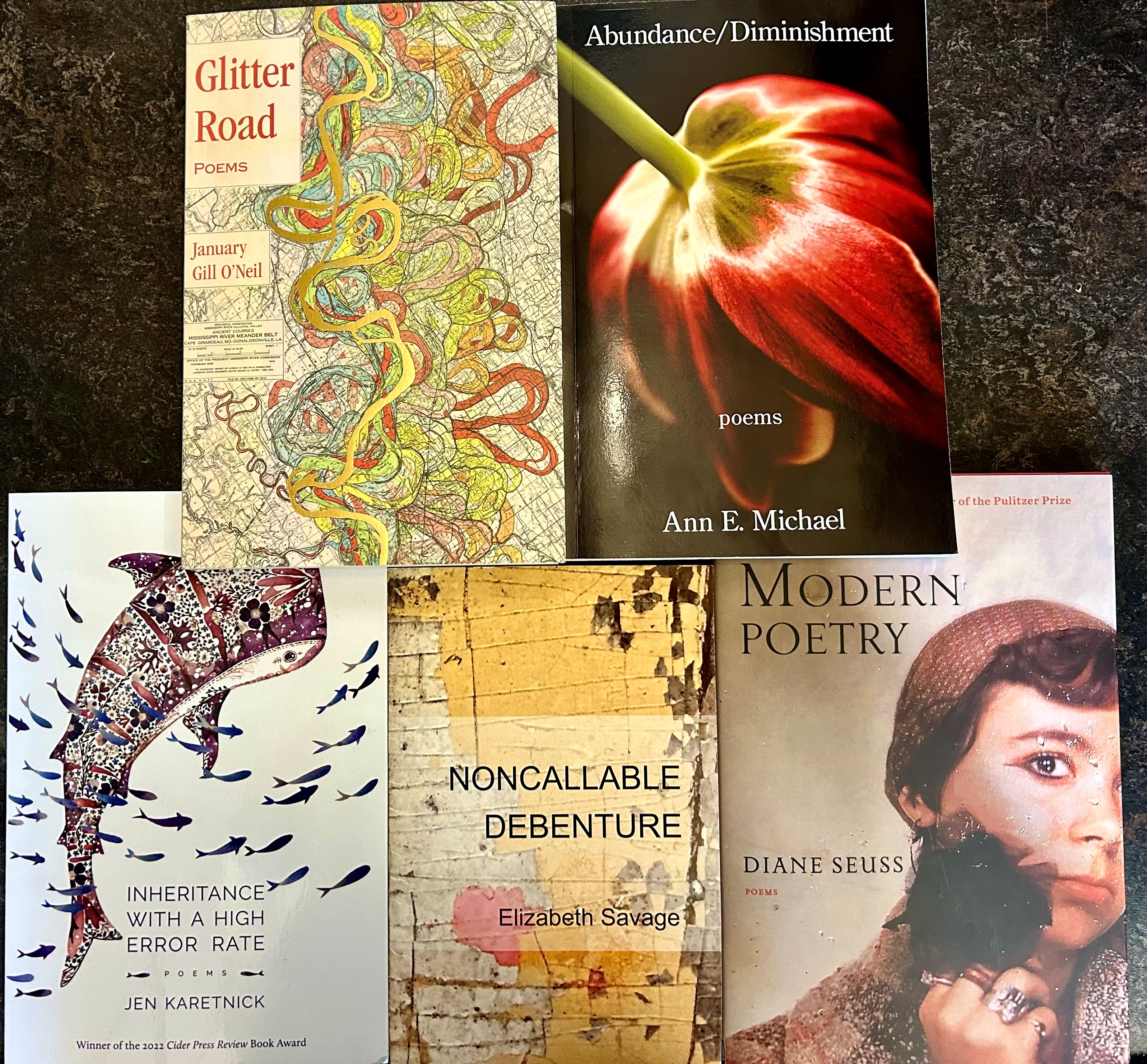
Modern Poetry by Diane Seuss, from Graywolf: The title tells you this book is ABOUT poetry, especially what the opportunity to study poetry means for a young person from a “desolate town” and with no expectation that her life might be beautiful. Yet while the pieces about reading, writing, and studying poetry are wonderful and sharp and often funny, I felt rocked to the core by the many other poems here about music. From “Threnody,” for example: “I don’t cry on the outside./ I haven’t reached that level of liberation/ from the granite my angel is trapped in.” Oof–close to home, for this person who cried incessantly for twenty-seven years and then suddenly, fed up with my own rawness, stopped. Seuss talks to herself, to her son, to the dead, to dogs, and to us with extraordinary intimacy. I so welcome her flawed-self-revealing company!
I have a similarly eerie sense of connection with a sympathetic mind reading Ann E. Michael’s Abundance/ Diminishment. This book tallies losses and bounties: it’s full of mathematical and scientific language, but what it counts and categorizes is deeply emotionally freighted. In “Filling Out Forms at the Gynecologist’s Office,” she subtracts the number of her children from the number of times she’s been pregnant. In “Tongues,” a child of six, mocked by classmates for the tongue sandwich in her lunchbox, prices out peanut butter–even as she loses her immigrant mother’s language. Also like Seuss’s book, these is poetry of maturity, from a time of life when a person has to begin giving it all away. I’m especially grateful, these days, for books from midlife and beyond. I learn what I need to know by reading them.
Elizabeth Savage, Kestrel poetry editor and Lorine Niedecker scholar as well as poet, writes in a sparer style than any of the other poets treated here, although she has a mathematical sensibility that resonates with Michael’s. I read Savage’s evocative latest chapbook, Noncallable Debenture, as soon as it arrived (with a fistful of bills, appropriately enough). The prices she calls our attention to relate to enslavement, colonialism, the prison system, and other kinds of violence; she also counts hours and seasons, sometimes with Dickinsonian elision or the sharp kireji of haiku; but other poems are thank you notes, instead, for gifts and connections. These are models for paring back to what matters.
Inheritance with a High Error Rate by Jen Karetnick, co-founder and co-editor of SWWIM, is the most ecopoetic book on this short list. Karetnick engages intensely with the environmental precarity of subtropical Florida, but she also threads personal losses into these formally various poems, including suffering through chronic illness as a “long-hauler” and mourning for beloved friends and family. I love this one, for instance, about what it takes for an ageing woman to get a man’s attention. Loss and beauty tend to travel together–I think I’m arguing for poetry of maturity again…
“No one has been where I am going,” January Gill O’Neil writes in Glitter Road. I’ve admired all of O’Neil’s books but this is my favorite–mostly because it contains so many terrific poems, but also I’m impressed by how she weaves personal and public histories together, tones of anger and joy, and somehow makes the highly various tapestry shine. What holds it together is the mystery of how a person (and a country) gets from there to here: from cotton plantations to Ole Miss students vandalizing Emmett Till’s memorial; from widowhood through John Grisham’s bed to good sex. As she says in “Cartwheel,” “That I go through the turn/ and keep landing on my feet/ is a goddamn miracle.”
The books I’ve been picking up, in this tight window before Shenandoah submissions and student essays pour in, are not only by grown-up women but by generous poetry citizens–people who, in myriad ways, read, champion, and amplify the voices of other poets. Mediumistic magic! I hope you’ll support these authors and their presses with whatever powers you can call down to help us all.

5 responses to “Ectoplasmic micro poetry reviews”
Thanks for these mini-reviews; I’m honored to appear with such terrific poets! And now I have to get these books, because they all sound wonderful.
Hang in there until the semester closes!
A great catchup on what’s going on in poetry. And those covers! Thanks for popping this up, Lesley.
[…] that this week she included a mini-review of my brand-new book, Abundance/Diminishment (“ectoplasmic micro poetry reviews“). My book was in such good company! See the link above, between parentheses, for her […]
[…] Lesley Wheeler, Ectoplasmic micro poetry reviews […]
I’m sitting next my tottering stack of unread books, many on my era of usefulness to my Project (early Modernism with work in the public domain) and I’m thinking “I gotta read that new Suess book.” I believe I read one excerpt published earlier and it was great. Your short review tells me this more so.