The Poets for Science Gathering at Kent State kicked off with a staged conversation between Diane Ackerman and Maria Popova. However, because tornado warnings (!) shut down flights from JFK that morning, Popova participated virtually as a giant projection looming over Ackerman. The tech was glitchless—the whole conference glided along exceptionally smoothly, thanks to a skilled team behind the scenes—but I admit I was distracted, at first. She is so well-moisturized, I marveled, gazing at Popova’s enormous glowing head.
Soon, though, they were speaking about Marie Howe, Walt Whitman, and the distinction between wonder and awe, and I was hooked. From Ackerman I scribbled down a phrase about poets trying to “eff the ineffable”; from Popova, a claim that art springs from “the devastation of our hopes.” (Well, sometimes.) At some point Popova uttered the word that, for me, tuned the whole weekend. Of an intense experience, she said, “it unselved me.”
In being struck by that word—or struck anew, because I’ve surely come across it before?—I’m late to the self-decomposition. This way of describing ego dissolution in encounters with the other-than-human world is common enough in ecological writing. I didn’t know, though, until I came home and looked it up, that Gerard Manley Hopkins coined it in his poem “Binsey Poplars.” The combination of phonemes in the world is beautiful, and so is the idea behind it. Poets for Science was, in fact, short on egotistical display. Scientists, scientist-poets, poetry-curious people, and poetry-dedicated folks from within and beyond the academic ecosystem mingled and listened to each other with real attention. It was lovely.
Sometimes I feel too porous at gatherings like these and need to recuperate in big chunks of downtime between sessions. Here the ethos, though, was being present for everything—even among the big shots—and this modestly sized shot almost was. I missed an evening reading because of an allergic reaction at Friday’s dinner; worn out on Saturday but determined to hear Jane Hirschfield and Arthur Sze read that night, I skipped the book fair. I learned something from every event I attended, filling my notebook with scraps that one day might be poems. This episode of travel in busy November meant I was slammed by make-up work as soon as I arrived home; presenting on two panels, one at short notice, meant cramming in many hours of preparation beforehand. I regret nothing, except missing those two events.
This leaves me with little time now to report back, but I’m determined to document an element of “Mycelial: Inspired by Fungi.” My co-panelists Mildred K. Barya and Anne Haven McDonnell, as well as writing moving and memorable poems, are knowledgeable foragers. Both bring unselved attention to the mycoverse, although Anne leans a little harder on scientific research, Mildred on spiritual experience (they also live in different areas of the US, New Mexico and North Carolina, so the species differ). Our conversation with the audience afterward branched out in wonderful directions. Because I’d like to write (or collaborate on) some kind of manifesto for a mycelial poetics one day, I gave the packed room little slips of paper on which to write a related word or phrase and collected them after. This weekend I transcribed and tried to group them. You’ll see the categories are too interpenetrating to quite work, but for now, here they are. Shout-out to everyone who didn’t close their parentheses. Charles Olson didn’t either, seventy-something years ago, in describing projective verse, but mycelial poets, surely, borrow and trade from the dead as well as the living. As Mildred observed about lobster mushrooms gaining flavor after eating other fungi, poems eat other poems.
Mycelial poetics as a formal practice:
- recycling, mulching, composting
- form=erasure > turns into > ?? / cento / cowritten or collaborative poems
- collaboration / forms—erasure + centos + epistolary (back to form / interacting / responding
- community poems—each person contributes a line
- poems with fruiting bodies—maybe a long line of rambling text then a block of stanza text arises
- verbness / entangled
…centering on death and rebirth:
- decomposer
- also regeneration as a move toward truth
- transformation. Life from death
- undone so many
- loamy, dank, felt in the mouth
- Westerners overemphasized Brahma’s importance in Hinduism as he is the creator, like the Judeo-Christian god. But there are only a handful of temples to Brahma whereas Siva & Vishnu (of whom Krishna is an incarnation) are far and away the dominant deities of Hinduism. Destruction & maintenance lead to transformation.
- TRANSFORMING / TRANSFORMATIVE
…as an underground art:
- Mushrooms invite us to wonder, but they preserve their idiosyncrasies in a way that seems like a cautionary tale against mastery (i.e. they can grow beyond our sight) Their mystery is alluring
- spindly creepy sneaky
- Mushrooms – incentive for closer attention / Also, mystery!
- Love this panel! mushrooms – for poets, they seem like a creative impetus for greater precision and accuracy (as in “Mushrooms” by Anne Haven McDonnell
- rhizomorph
- loamy, dank, felt in the mouth
- family, birth, death, transformation, body, brains, a record of time; archive
…as an art of relation:
- interspecies connections
- love the notion that foraging requires apprenticeship to the soil
- mycopower
- microbiome, microworlds
- white entanglements below soil
- godparents, / giftparents, / of the forest
- my father nurses his sugar maple seedlings with lanolin and they shot up tall, spindly, weak—then he tucked granules of mycelia around the roots and they grew
- finding my way / through the soil / a turn that way / a return this
- as I am, I am worthy of love
- PRIMAL INTERWEAVING
- interdependence
- Rain
- cosmic fungi: the fungi of the universe, the multiverse; communication & longing
- a craving / hunger
- Mustards, the standoffish family that won’t dance with mycorrhizae


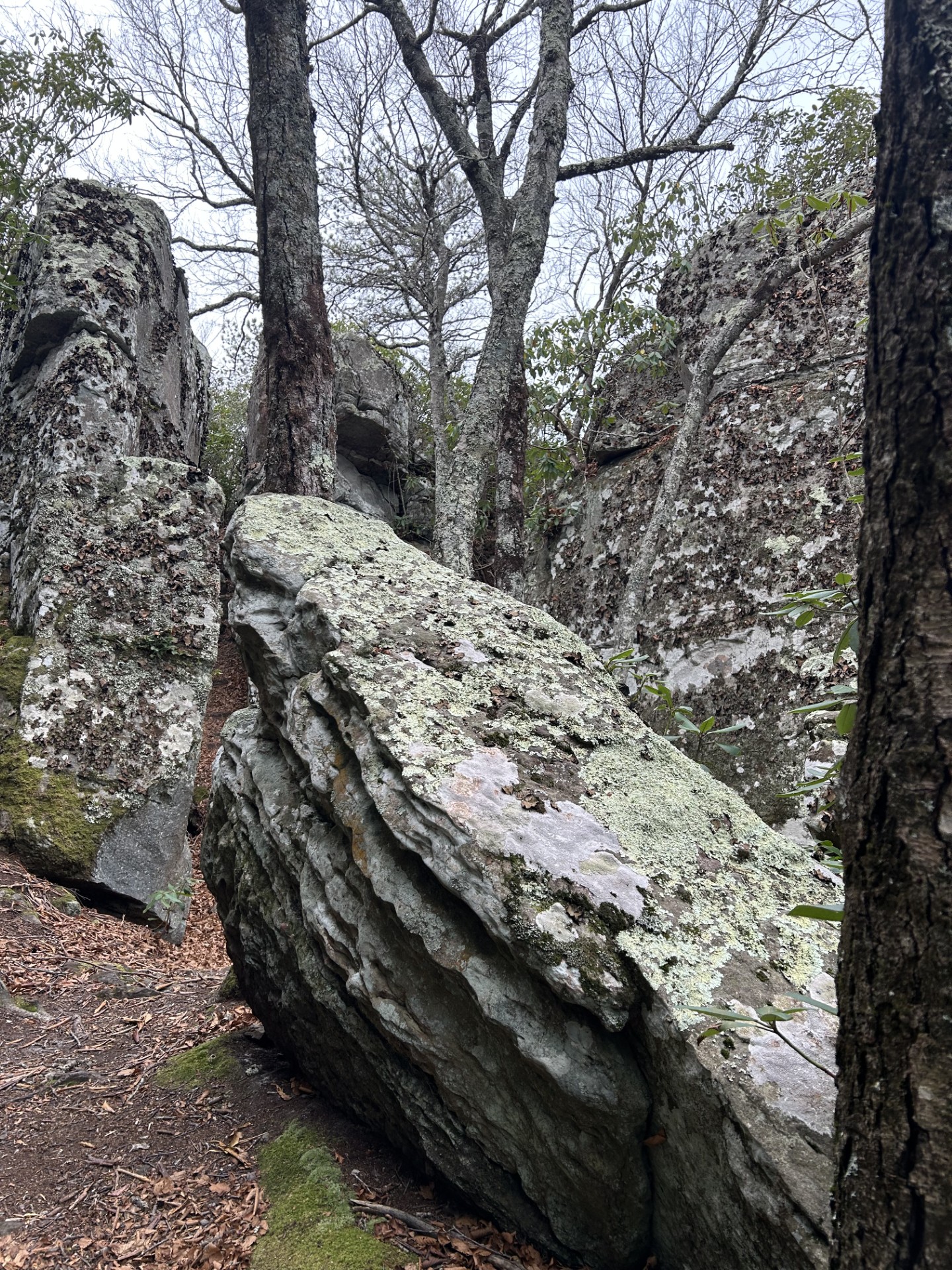
Above, from a hike with scientist friends on North Mountain a few days before Thanksgiving. The view is from the other side of Big House Mountain and Little House Mountain than the side I see from my desk. The lichen-crusted sandstone boulders are known as “Pete’s Cave”–really a rock island, said the geologist, and perhaps a million years old.
2 responses to “Unselved & decomposing”
I’ve been jealous of every report I’ve heard from that conference (but I did get to see Popova and Ackerman (and Howe) in person recently, so there is that). Sounds like it was very rich. I wonder if you are aware of Canadian poet Clare Goulet, who has an obsession with lichen that I think you’d appreciate. Here’s a link to Rob Mclennan’s review of her book Graphis scripta, https://robmclennan.blogspot.com/2024/08/clare-goulet-graphis-scripta-writing.html
That looks like an amazing book–thanks so much for pointing me to it! Orchid Tierney has a wonderful little book on lichen, too. Sounds like a poetic subfield sending out hyphae.