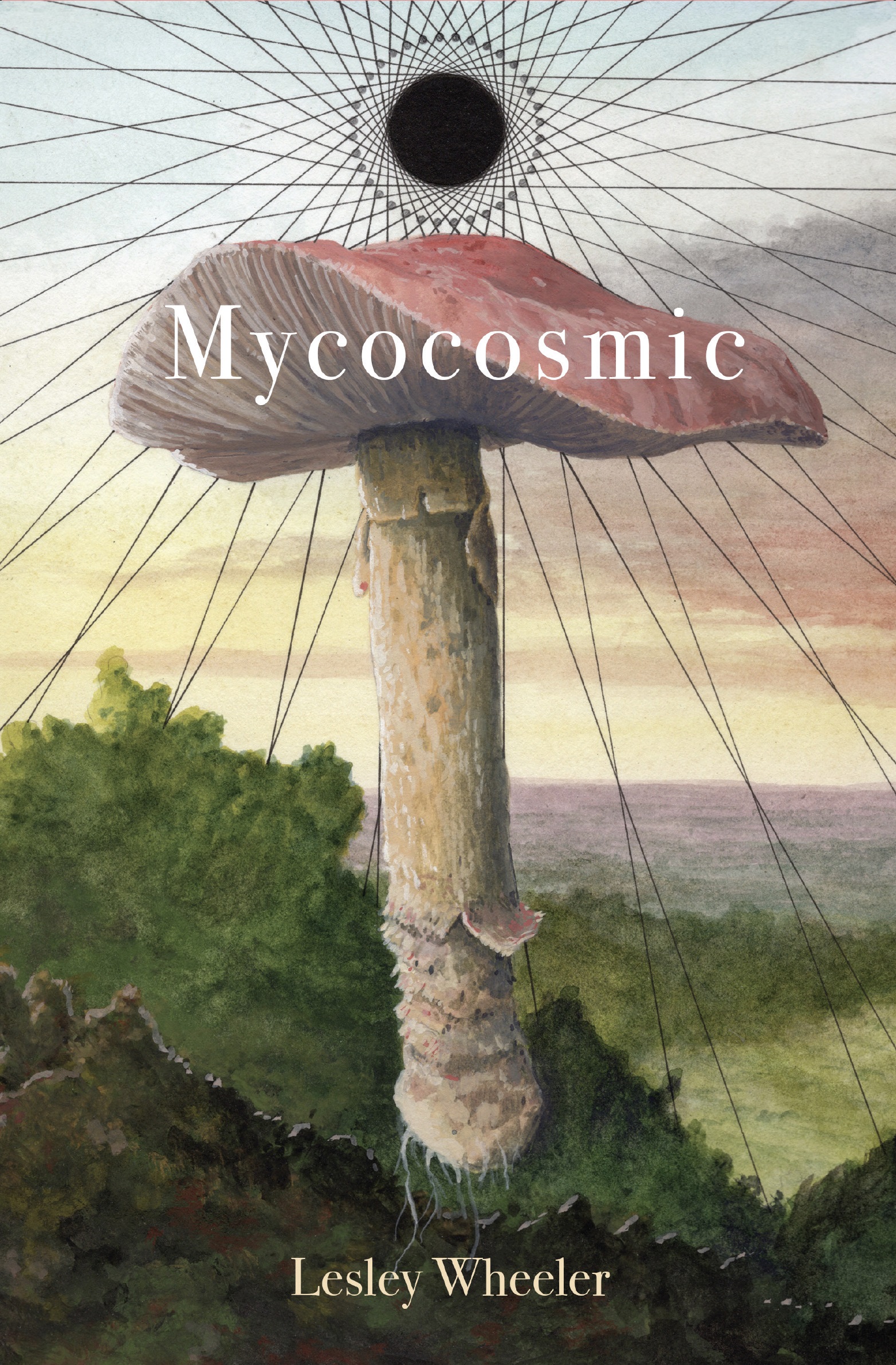
A LitHub Notable Small Press Book
Available from Tupelo Press, Amazon, or your favorite independent bookstore!
Tupelo Press, March 2025, ISBN: 978-1-961209-16-9, 92 pages
Praise for Mycocosmic
‘People radiate light they cannot see,’ writes Lesley Wheeler in Mycocosmic, a brilliantly structured book that glimmers with tensions and betrayals, that blazes with gratitude and resilience. Wheeler’s language is alive on the page; it pulses with a perceptiveness that braids thought and sensation into imagery that startles, shines. The footnote-poem is striking—a lyrical summoning that enriches and complicates. Mycocosmic is a marvelous book that demands and rewards multiple readings. —Eduardo C. Corral, author of Guillotine
Lesley Wheeler’s Mycocosmic is a hymn to our shiftiness and interconnection—the inevitable metamorphosis of corporeality and desire and memory. These exquisitely wrought, multivalent poems thrum through their bodies with “the persistent, mysterious, the hungry electrical process of love!” Using mycelium as an extended metaphor and underpoem girding the footers of Mycocosmic, Wheeler revels in and explicates the dark and dazzling energy of sex, death, motherhood, family, and the female body to create a new narrative of transformation. —Erika Meitner, author of Useful Junk
Lesley Wheeler’s Mycocosmic embraces mushroom-as-metaphor in these wholly original, stunning poems. Fungi as food, as medicine (including psychedelics), as persistence, as underground webs of connection and resistance. These magic mushrooms of poetry sing of the body, the body politic, the terrors and pleasures of childhood and death. Employing sonnets and tarot cards, spirituality and science, Wheeler’s obsessions become the reader’s. Underneath each poem, lines from a cento are growing in an inventive form Wheeler makes entirely her own. —Denise Duhamel, author of Second Story
Mycocosmic wins a blue ribbon for most elegant handling of death to the underworld of mushrooms, the living beings that turn death into sustenance, and into new life again. From a palpable position of accumulated grief thinly masked by scientific curiosity, these poems sift through the earth in search of connection, closure, variants of peace, and the emotional alchemical knowledge of turning loss into its next inevitable iteration. —Angela Chaidez Vincent in Lit Hub
Mycocosmic, a riveting collection of poetry by Lesley Wheeler, entices the reader to examine the vast underpinnings of family bonds and strife, of mothering, daughtering, grief, joy and renewal – all through a series of daring, breathtaking poems. —Laurel Kallen, “Following Filaments” in Action, Spectacle
Her works are acts of creative transcendence, producing a gorgeous and enthralling collection in a voice resoundingly her own. Mycophiles will find delight and discovery in the bold new ways of perceiving fungal realms above and below–marvelously rendered not by the camera’s lens but deep in the mind’s eye. —Maya Han in The Mycophile Quarterly
It’s ecological in a way that makes you believe again in the superpowers of nature and feminist in a way that makes you examine your own behaviors and shames. —Jeannine Hall Gailey, author of Flare, Corona
About Mycocosmic
“Good things come to you through fire,” a Tarot reader told Lesley Wheeler as she was composing what became her sixth poetry collection, Mycocosmic. But how could that be true, while the planet was burning and life slamming her with one loss after another? Then she learned about pyrophilic fungi that lurk in soil until activated by fire. Enter mycelia and a teeming underground world that metabolizes death, changing what remains so that life can begin anew.
Mycocosmic offers intricately woven spell-poems—prayers, hexes, charms, and invocations—that call for transformation. A parent’s death gives Wheeler freedom to reveal difficult truths about family violence and her sexuality; a midlife mental health crisis transforms her sense of self. Incantatory language channeled through a wide variety of forms—including free verse, litany, sonnets, the bref double, the golden shovel, and the villanelle—empowers these shifts.
Beneath these poems runs a book-length essay in verse, “Underpoem [Fire Fungus],” sending tendrils across the footer of each page. This poetic mycelium nourishes metamorphosis and highlights its urgency. As Merlyn Sheldrake writes in Entangled Life, “Mycelium describes the most common of fungal habits, better thought of not as a thing but as a process: an exploratory, irregular tendency.” Poetry is rooted in real and imagined communities and conversations. Mycocosmic demonstrates how interdependence binds us together.
 LESLEY WHEELER