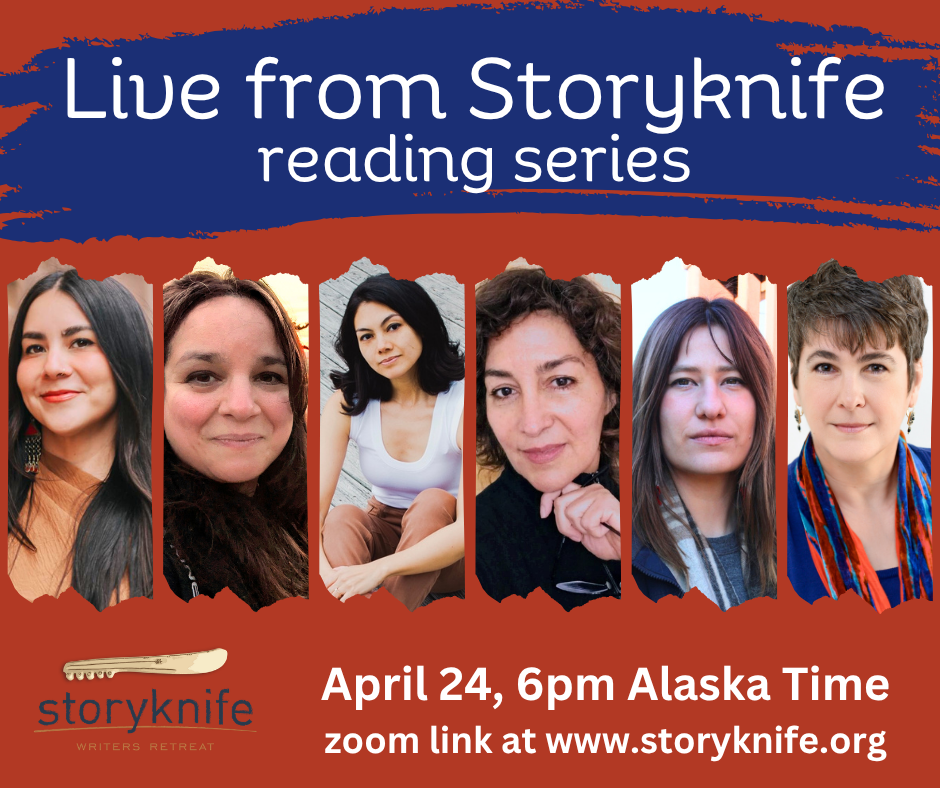
I’m heading to Alaska shortly. During my residency, blogging and social media will be low priority, but my Storyknife cohort will give a virtual reading on April 24th, 6 pm Alaska Time–I’m planning to share new work with you, if you can make it. Look at the Storyknife website closer to the date for a link, on the Live from Storyknife page. And big thanks to MER for featuring a poem of mine in their new issue. There’ll be a couple of issue launch readings in June. In the meantime, more of my early spring journal is below.

April 1, 2026
My mother died five years ago this month and it’s been weighing on my sister and me. Spring is my favorite season, and grief doesn’t spoil it, but it does intensify my sense of how short-lived everything is—the succession of flowers, trees budding before they leaf out into a long summer normal.
This morning I learned that my mother’s sister Bobbie died. She’d been in hospice for only a couple of days. My English grandmother had four children, all born in the late 1930s and early 1940s, so they were infants and toddlers while Liverpool was heavily bombed. Tony, Bobbie, Pat, Peter: my mother was the third. As young women, Bobbie and Pat emigrated to the US and married here, while the brothers raised their families in England (mostly–Peter was in the British military). Bobbie, her husband, and two daughters lived in Connecticut while mine lived in New York then New Jersey, so we saw a lot of them when we were kids.
I thought of my aunt and mother as opposites, back then. Bobbie completed her schooling in the US and worked as an RN; my mother stayed home with the kids. Bobbie lived in the woods, ate interesting food, smoked a pipe, and did the New York Times crossword in ink over a nightly glass of wine; my mother lived in the suburbs, cooked roasts, read romances. I thought my mother was quiet and Bobbie was fun, but it’s more complicated than that–Bobbie also had an intensely shy side and my mother a sly sense of humor. Bobbie remained a fierce Scouser, even in her accent, and kept her British passport; my mother’s Liverpudlianisms burst through the Queen’s English only occasionally, and her Englishness faded as she went all-in on becoming American. Of course, while those bare facts about their lives are true, they’re partial and don’t define either of them. They reveal more about my own math, I think, as I tried to analyze the options on my path to growing up.
I have a vivid memory of a warm day in late spring, picking strawberries from a patch in Bobbie’s yard as I examined the seeds and leaves. I learned by tasting which would be sour, which sweet. Here, today, the redbuds are blooming. This week I saw big fat false morels sprouting around a tree stump in someone’s front yard. Spring’s at its old tricks, breeding lilacs out of the dead land, yadda yadda.


April 5, 2026
First trillium bloom today, along the Chessie Trail, and Dutchman’s breeches. On the back campus trails Friday, toothwort. Also, what my app tells me is an invasive plant, “Incised Fumewort,” a heavy name for a tiny purple flower.
I just finished Joe Hill’s monstrously long novel King Sorrow. I liked it, and for the last hundred or two pages couldn’t put it down. When I come to the close of a long novel or book series, a funny mix of feelings hits: pleasure, if the end is satisfying; sadness that a set of characters and the world they live in will fade out of my own reality now; and release. I can finally look up and around! Read other things!
My youngest is home from his spring break and his girlfriend is visiting, though, so I’m still distracted. My eldest, meanwhile, has started a promising medical treatment, about which we all feel wary hope.
April 6, 2026
My son and I took my ordinary walk today, along Woods Creek, and I pointed out things he could pull from the ground and eat. Weirdly, he seems to like this, and thought deadnettle was tasty. I never knew what that little purplish plant was until this year, although it grows everywhere—all part of the very long process of learning where I live.
Last year I read selections of Joan Naviyuk Kane’s work for one of those anonymous evaluations I’m not supposed to admit to doing. I admired it so much, I put in an advance order for her collection with snow pouring southward past the window, just out from Pitt. Funny how I keep reading books about foraging, but I especially wanted to taste this one before heading to Alaska in a few days. As her bio describes, Kane is “Inupiaq with family from Ugiuvak (King Island) and Qawiaraq (Mary’s Igloo), Alaska… She’s raised her children as a single mother in Alaska and Massachusetts, but now lives with them in Oregon, where she is currently an Associate Professor at Reed College.” Stephanie Adams-Santos writes in her back-cover endorsement that the poems are “marked by an insistent naming of plants, people, places—an act of preservation against all that slips away.” Many poems in with snow have a quality of litany (although there’s also one called “No Litanies, No,” so maybe don’t trust my impression). In “Without Anchorage,” she writes about trying to “harvest the tops of onions flash-frozen with approximate winter’s sudden onset, haul the tenderest medicines inside losing only the laurel: hyssop, arnica, basketgrass sagrit.” The lovely precision, though, is framed again and again by the pain of displacement. To some extent art can conjure possible worlds and preserve in them what has been or will be lost. It’s never a fully adequate answer to grief, but I’m moved when artists try.
I’m at least as struck by how these poems witness and answer violence on many scales, including brutality in Kane’s childhood and massive cultural violence. There are also a host of poems about men being assholes. “Letters from Learned Men,” an erasure poem, documents a contemporary priest writing in a condescending way to someone who seems to be Kane herself (the name is blacked out)—and concludes with a hundred-year-old letter in which a priest condemns a Native woman in an overtly vicious way. I love how this poem levels a devastating argument by mere juxtaposition: historical racism and sexism are continuous with their lightly disguised contemporary versions. In fact, I love all of the many angry poems here—as well as the book’s lack of a Notes section. “The first thing I will do: make / myself indecipherable / to you,” she writes in “Elixirs for Words to Come.” So you don’t know my language or landscape or cultural context or even why I’m mad? If you want to navigate this poetic world, it’s on you to figure it out.
*I can’t find any of these poems online to link to in this blog post, but here’s one from this book: “After Anchorage IV.” It’s part of an intermittent series laced through the book. She riffs throughout on the roman numerals, so this is also a poem that sticks a needle in.
April 7, 2026
I’m printing out new poems ahead of my Storyknife residency (which starts on the 15th, but Chris and I fly out on the 11th to spend a few days seeing the other side of the Kenai peninsula). The idea is to see if a new poetry collection is beginning to shape up, and if so, what’s missing, what kind of poems I still have to write. I’ll have my own little cabin where I can lay poems out on the floor, as one does. The working title so far is Spiral Hum. I’m not in any rush, but this feels like a good moment to take stock.
A brisker day than we’ve been having—chilly breezes toss the flowers, but the sun is shining. Tonight I’m joining a student-run open mic to benefit Project Horizon, the local support hub for people coping with domestic violence.
April 8, 2026
I’m also prepping for this residency by reading books about spirals (mostly too heavy to pack). A few days ago I revisited Jane Alison’s Meander, Spiral, Explode: Design and Pattern in Narrative, thinking about how the spiral pattern might translate into a structure for a poetry collection. Now I’m in the middle of Nico Israel’s Spirals: The Whirled Image in Twentieth-Century Literature and Art. It keeps flinging my attention toward other writers and thinkers. From Roland Barthes’ The Responsibility of Forms: “on the spiral, things recur, but at another level…nothing is first yet everything is new” (qtd. in Israel, 22). It hadn’t settled into me yet that I might be drawn to spirals not just because it’s a powerful form in nature and the visual arts, from Neolithic carvings through Spiral Jetty. The shape probably also haunts me because I’ve been reading modernist poetry for my entire adult life. I don’t think I can write good poems about Yeats’ gyres or Vorticism—sounds like an elitist thing to attempt, doesn’t it?—but they’re certainly swirling around in my imagination.
On the looping back campus trails this afternoon I looked for and rediscovered a replica of Thoreau’s cabin that an English major built as part of his senior project in 2012. It made me happy to spot a current student reading an actual book on a sunny western slope, amid the meadow-rue. It still happens.


