March 23, 2026
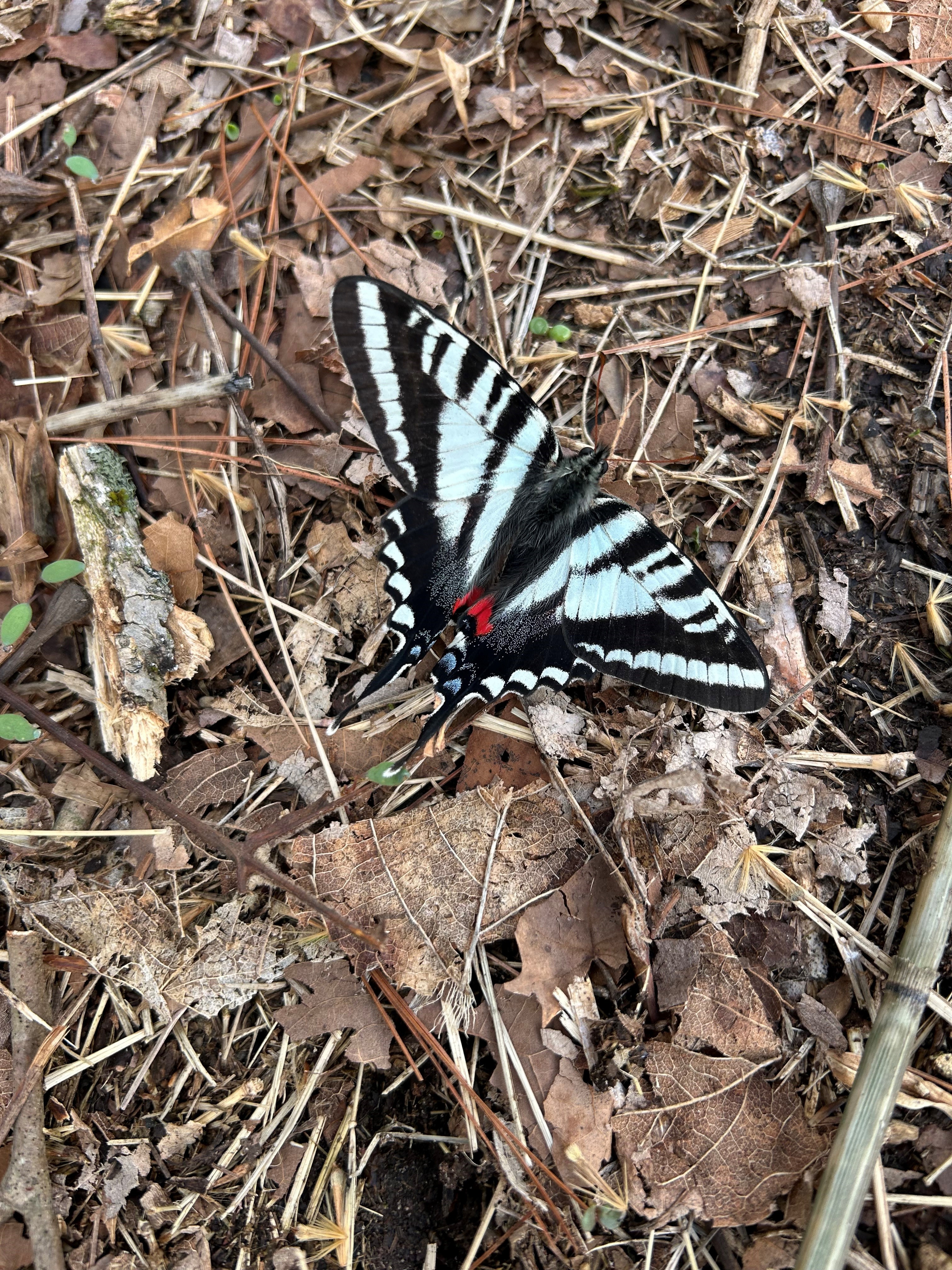
This morning I took my first solitary ramble of the new season in the woods behind campus, a favorite walk, especially in spring. The ridges folding steeply down to the Maury River are full of spring wildflowers: this early I found lots of twinleaf and spring beauties (a.k.a. miner’s lettuce, good to eat). Polypore fungi and greenshield lichen ruffled the fallen logs. Virginia bluebells will bloom later, but some are budding. I saw no people, just a doe and squirrels, and the birds were noisy. Once I came across a zebra swallowtail resting on the path as if waiting for me before it launched. I was surprised, when I returned to my car, to find two hours had passed.
I’m trying to be a butterfly today, resting and following whim, so after lunch I make a pot of tea and finish reading Patricia Ononiwu Kaishian’s Forest Euphoria: The Abounding Queerness of Nature. I started it in March 2025, thought it was wonderful, then put it down for a whole year. I’ve spent a lot of the last 15 months on the road with Mycocosmic with intense intervals of novel revision—is that why I stopped? I read other books. But the essays in Forest Euphoria are intense, as lush and alive as thriving woodlands. The author is a mycologist; her knowledge of and love for flora, fauna, and funga crowds the pages. Maybe it was too much for my tired brain.
I settle down to the last chapter, “Spring Ephemerals.” Beginning with the date “April 12th, 2023,” in the Catskills, its entries document Kaishian’s favorite “sit spot” before she moves to a different part of New York, and the benefits she derives from retreating to the same place frequently to rest and think. “In deciduous forests,” she writes, the spring ephemerals she waits for “evolved to grow during a period of reduced canopy coverage, when more sunlight reaches the forest floor” (189).
I don’t have a regular sit spot unless it’s on our screened-in porch. I watch birds there and the progression of a dogwood from bud to bloom to leaf to berry. Under that little tree, I grow garlic chives (already sticking their spears up), lemon balm, mint, and, close to the sidewalk, lavender. Skunks and possums cruise by at twilight and startle the hell out of me. Some dogs on their daily walk down my street pause, stretching their leashes, to sniff toward me and my wary cats. Students stride by, talking loudly on phones held in front of them and set to speaker (why do people do that?!). In summer, some walkers stroke the lavender and sniff their hands.
Sitting there, listening and looking and sniffing the air like one of those golden retrievers, I decide to chronicle my spring as Kaishan did hers. I’m not planning to write daily or about the same place each time. I’ll spend part of this spring in Alaska, after all. I don’t need prompts or writing pressure. In fact, I don’t have a destination or ambition for this writing at all, although I’ll post some of it on my blog. It’s ephemeral.
The wind has picked up after a mild morning, whistling around the corners of the house, though the sun shines.


March 24, 2026
A friend just told me that the zebra swallowtail’s larvae can only eat pawpaw leaves. Another said it was his holy grail species as a kid in New Jersey, though he never found one.
Some quotes from Forest Euphoria that made me dogear pages:
5: “…my gender identity remains shifty, still ambiguous and amorphous. Am I a woman? Am I nonbinary? To be honest, I’m not sure. For some people, gender identity is a very clear matter, and they recognize their sense of clarity as a gift. My own lack of clarity sometimes feels like a burden, a series of looping questions that never end, but most often, I consider this ambiguousness a gift of its own.”
89: Kaishian wants to “myceliate the practice” of fungal taxonomy, “decomposing its Victorian and colonial cultural artifacts.” A moving ambition and a great verb!
97: On looking for intelligent life in outer space and in/on earth: “We want to be spoken to.”
216: On a 19th-century woman mycologist (that rare species), Mary Elizabeth Banning: “I want to see Banning’s legacy sporulate.”
March 27, 2026
I’m carrying a heavy sense that something is going to happen, something not ephemeral. Lots of news-checking and kid-checking: each of my adult children is going through a hard time. The cat was squinting through a pink left eye this morning, vomited his breakfast all over the place, and I had to hurry him to the vet. He seems okay now, but twice-a-day eye drops will be an epic battle. Clouds hang over House Mountain and the neighbors’ dogs are barking.
I read another book I loved. Anne Haven McDonnell’s new poetry collection Singing Under Snow is the perfect partner to Forest Euphoria. I don’t think the authors know each other, but their work connects: both books concern awe and walking in the woods; funga and queerness; solitude and interrelation. A kind of hush seems to hang over most of Singing Under Snow, which contains a gorgeous series of odes to mushrooms—a disposition to awe. Smell and taste and touch are vibrant, as opposed to the visual detail that dominates much poetry. A sautéed Agaricus agustus has “browned base notes in butter, high hint / of marzipan.” Inky caps “stink of squid.” Truffles emit an “intimate funk, maybe old cheese, oak, sweat, rot, maybe sulfur or leather or brine…it’s a low cello starting in the feet.” All this mushroom sniffing is entangled with memories of beloved people, who sometimes accompany the foraging. “Every love I’ve known,” Haven McDonnell writes, “I remember by her smell—maple syrup, soap, salt, moss, fur, cinnamon, yeast, sap, snow.”
I love how much humor is here, too, though. “What is it / with lesbians and owls?”


March 30, 2026
This weekend I dreamed that my problem joints (knees, hips, an ankle that requires babying) were replaced by faery joints (in the dream, I knew faery was spelled with an e!). They looked like cloudy ice or crystal. I like the idea of being a human-faery cyborg.
I finally obeyed what’s supposed to be a firm no-work rule for my sabbatical weekends and it helped a LOT with the jangling, doomy mood. Saturday my spouse was speaking, serving as marshal, and otherwise helping organize our small-town No Kings rally. I mainly read at home, heading out just for the rally itself. Sunday we drove forty-five minutes to take a short hike around Sherando Lake in the Washington and Jefferson National Forest. It’s a beautiful place, but a little higher and cooler than Lexington, so signs of spring were far fewer. I’m scouting for morels everywhere but no luck so far.


3 responses to “Spring ephemerals”
I used to do sit spot sessions with my fourth graders. They went to the same spot (in our courtyard) monthly and drew a regular picture, a zoomed in picture, and wrote descriptions or questions. They loved it.
I love that so much!
[…] Lesley Wheeler, Spring ephemerals […]