And woe betide that poet whose life, when the gossip-columnist-reviewer goes to work on it, does not reveal fornications and adulteries, drug-addictions, alcoholism, and spells in mental homes. “What?” the reviewer exclaims, “when it appears your poems have cost you so little, when the writing of them has apparently disorganized your life hardly at all, can you expect me to give them as much attention as the poems of Miss X here, whose vocation drove her last week to suicide?”
Donald Davie, “Sincerity and Poetry,” Michigan Quarterly Review, January 1966
Miss X, indeed. Davie is SO condescending in this essay, AND funny in a way that makes me wince, AND smart. There’s another passage I dislike, in which he skewers the kind of poet “who confesses to discreditable sentiments or behaviour, but in doing so he demands credit for the courage or the honesty of his shamelessness”–hmm, what do you mean by “discreditable,” Mr. Davie? However, he’s writing from a decade in which, arguably, “poems indeed have their value less in themselves than as pointing back to the lives that they have come out of,” and while he’s obviously ambivalent about it, he also observes that poetry of sincerity can support necessary revolutions in a way irony and ambiguity can’t. Although skeptical of the increasingly large importance of personality in poetry, he ultimately sides with his contemporaries’ rejection of New Critical approaches: “Why is it so important to us as critics to seal off the world of literature from the adjacent worlds of biography and history and geography? What are we afraid of?”
There’s more to say about the essay–I’m fascinated by the ending, in which he talks about poetic sincerity as its own kind of controlled performance in persona, and I tend to agree–but what has me writing this post is how I feel as I think through his arguments (and the snappy, snarky prose that delivers them): weirdly relieved. It’s helpful to remember that the emphasis on identity in contemporary writing is not inevitable and in fact goes back a while. Also, the sales and prize triumphs of glamorous, photogenic poets is a historical phenomenon rooted in the explosion of mass media (although I’m pretty sure the relevance of wealth and connections to literary success goes WAY back). Expressive poetry rooted in identity: I agree with Davie that it’s important, but also that there are downsides to its dominance. Maybe those factors and fashions are here to stay…but maybe not.
The new term has begun here and I’m teaching three courses: an introductory poetry writing workshop; a general education-level class called Poetry & Music, which begins with meter and rhyme and other ways of considering “sound” in print poetry, then moves to poetry’s intersections with forms of popular music; and an upper-level seminar, Poetry & Authenticity, that ranges from the Beats through more recent US poetry, with an emphasis on what it means for poetry to get real. The latter is why I’m rereading Davie. Teaching is obviously going to keep me busy, and I’m wistful already about the introspective days of early January, but also: as I jump into the swing of things, there’s that feeling of relief again.
I’ve been wondering why I’ve been longing to teach literature in my home scholarly field again, as I am now, because I also enjoy the writing workshops and speculative fiction that were on my docket in 2023. My latest thought is that I needed some relief from the very contemporary work in which my recent reading as well as my teaching has concentrated. I’ve been excessively driven by professional ambitions during my adult life, sweating the so-called failures more than I would like to. I tend to be all too aware of how the contemporary writers I read and teach jostle for social media attention, space in big periodicals, prizes, and the rest. It helps my sanity to shrug off that hyper-focus and go back to Ginsberg, O’Hara, Plath, Brooks, and others. I feel reasonably expert, well-read, able to swim in these old currents. Their work is personal, but it’s not personal to me, except in that I’ve been companioned by their work for so many years. Phew.
In this terribly sincere and authentic blog, I often put more personal and writerly news last, suspecting they’re less interesting, and here I go again. I’m still wrestling with some of the stressors I reflected on last time, and watching beloved people wrestle likewise, but I’m maybe feeling a little better, and I’m certainly back in a healthier routine (not unrelated). It’s affirming and fun to see some poetry events click into my calendar for winter-spring-early summer, a couple in Virginia and one in Scotland. I received my first poetry acceptance and rejection of 2024, and the latter was one of those tiered form letters with encouragement to try again, so that feels pretty good. I also slipped a couple of new submissions under the wire before teaching commandeered my brain. I was thrilled to see my 2020 novel Unbecoming cited on Substacker-nonfiction writer-poet-tarot reader-astrologer Cameron Steele’s list of “magical” books she read in 2023. See her full post at the wonderful newsletter interruptions here, but she calls it “one of my favorite novels I read this year, and not only because its plot includes both magic and menopause, two parameters of my own daily life. Wheeler is the kind of poet whose poems always make you wish there were more of her to read. Ghostly. Luminous. Fungal.”
We’re also working on adopting a kitten from the local shelter to bring a bit more joy into our wintry empty nest. You will certainly see pictures of him–stay tuned!
Sincerely yours,
Dr. Ms. Professor Unglamorous and Occasionally Discreditably Behaving Poet-Critic
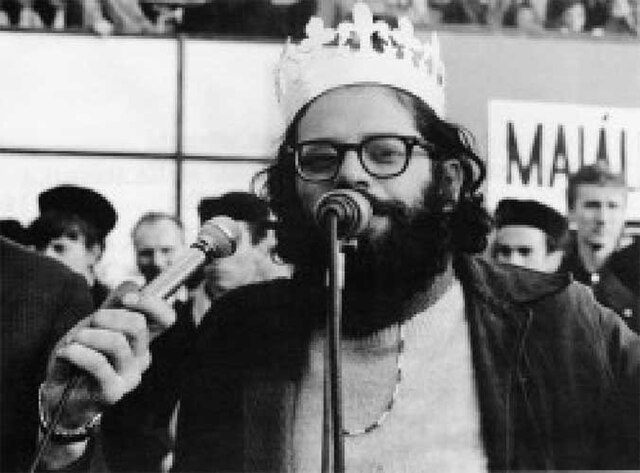
(Featured image is Allen Ginsberg in Prague, 1965, from Wikimedia Commons: https://commons.wikimedia.org/wiki/File:Praga_9_ginsberg.jpg)

5 responses to “Teaching the poetic 50s, with sincere relief”
Oh, to be luminous and fungal! 🙂
“I often put more personal and writerly news last, suspecting they’re less interesting, ” Not so! It’s all interesting.
Thank you!
[…] Lesley Wheeler, Teaching the poetic 50s, with sincere relief […]
Early this morning I was reading a long-form review that made the case that Keats was “sold” by his early 19th century circle based on a leveraged and oversimplified story of tragedy:
https://www.lrb.co.uk/the-paper/v46/n02/susan-eilenberg/hooted-from-the-stage
Having grown up when The New Criticism was still a thing, I flatter myself that I’m doing something fresh when I look at poems in the context of the poets’ lives (or their subsequent readers lives for that matter) — but the more I learn, it seems that New Criticism era may have been a modern historical blip — that before and after there’s a character being sold alongside the work.
Your poetry and music class sounds interesting.